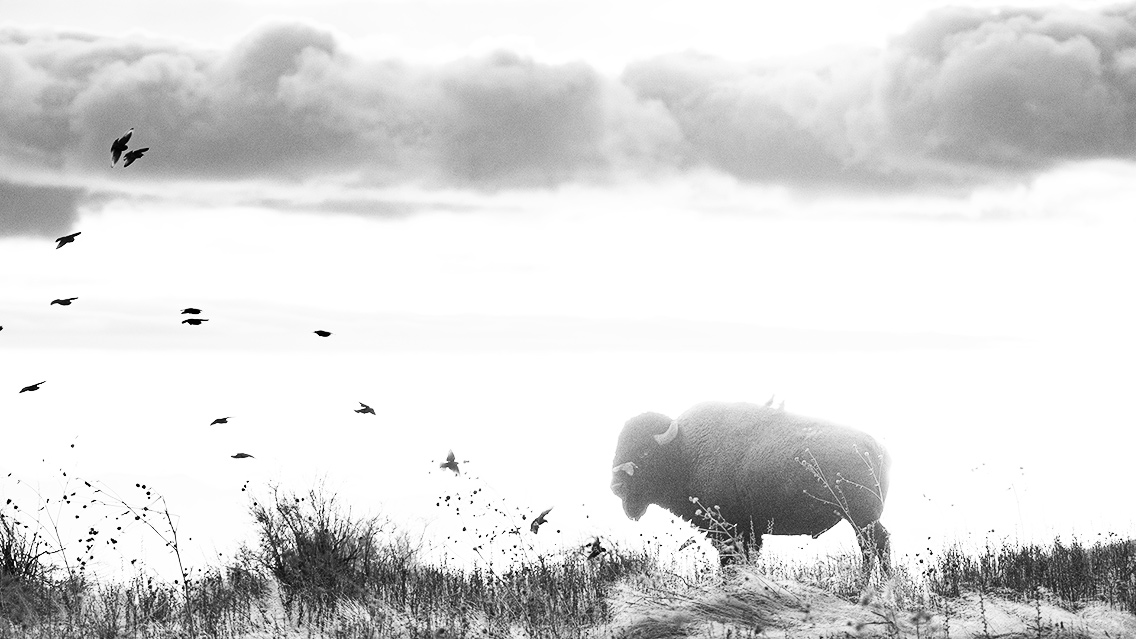
In nature, a bison and a bird operate in completely different ways. One moves through terrain with weight and force; the other moves above it with visibility and speed. They don’t share capabilities, and they don’t try to. But together, they create an advantage neither could achieve alone.

Their systems don’t talk to each other, so their people step in to bridge the gaps. Work gets done, but it takes more effort than it should, moves more slowly than it should, and relies too heavily on individuals rather than on design. Over time, this becomes normalized. Teams adapt. Processes evolve around limitations. What looks like “how the business runs” is often just a collection of workarounds. That’s the environment Bison & Bird was built for.
In nature, a bison and a bird operate in completely different ways. One moves through terrain with weight and force; the other moves above it with visibility and speed. They don’t share capabilities, and they don’t try to. But together, they create an advantage neither could achieve alone. The bird sees what the bison cannot. The bison clears paths the bird never could. Each compensates for the other’s limitations without changing what they are. That dynamic is exactly how we think about working with a business.
Most organizations don’t need to be rebuilt from scratch. They need clarity, alignment, and systems that actually reflect how work gets done. Instead of addressing that directly, though, they often add more software: a new platform for operations, another tool for reporting, a layer of AI introduced without a clear role. Each addition is made with good intent, but without integration, these tools don’t solve the underlying problem—they compound it. The result? A business that looks modern on the surface but operates with friction underneath. Bison & Bird exists to remove that friction.
We don’t approach this by selling tools or pushing predefined solutions. We start with how work actually moves through the business: where decisions are made, where delays occur, where people are doing work that shouldn’t require human effort at all. From there, we design systems that connect what already exists, introduce automation where it has real impact, and apply AI in a way that changes output—not just perception.
This is not about replacing everything. In most cases, the foundation is already there. The issue is that it was never designed to function as a cohesive system.
There’s a tendency to frame AI as a way to make things easier, faster, or more efficient. Those outcomes matter, but they miss the larger shift: AI changes what work should exist in the first place. When applied properly, it removes entire categories of tasks. It reshapes roles. It challenges assumptions that have been built into a business for years. That part is often avoided—because it’s uncomfortable.
But ignoring it leads to failed implementations. AI becomes another layer—another tool—rather than a force that actually changes how the business operates. Our approach is more direct: If something shouldn’t be done by a person, we remove it. If a process doesn’t make sense, we redesign it. If systems don’t connect, we make them. The goal isn’t incremental improvement—it’s operational clarity.
The relationship we build with clients follows the same principle as the bison and the bird—we don’t try to become the business, and the business doesn’t try to become us. Each side brings something distinct. The business brings context, experience, and an understanding of what matters; we bring structure, integration, and the ability to translate that into systems that perform consistently. When those roles are clear, the outcome is stronger than either side operating independently.
Working with Bison & Bird is not passive—it requires engagement, and it often requires change. We challenge how work is currently being done. We focus on outcomes, not activity. And we design solutions that continue to function long after implementation. If a system only works while we’re involved, it wasn’t built properly.
That standard matters because most companies are not failing due to a lack of effort. They’re failing because their effort is misaligned: too much time spent on the wrong work, too many tools solving the same problem in different ways, too little visibility into how everything connects.
At its core, Bison & Bird is built on a simple idea: before you add anything new, make what you already have work the way it should. Once that foundation is in place, AI stops being experimental—and starts becoming valuable.
Not as a feature. Not as a trend.
As a multiplier for a system that finally makes sense.